
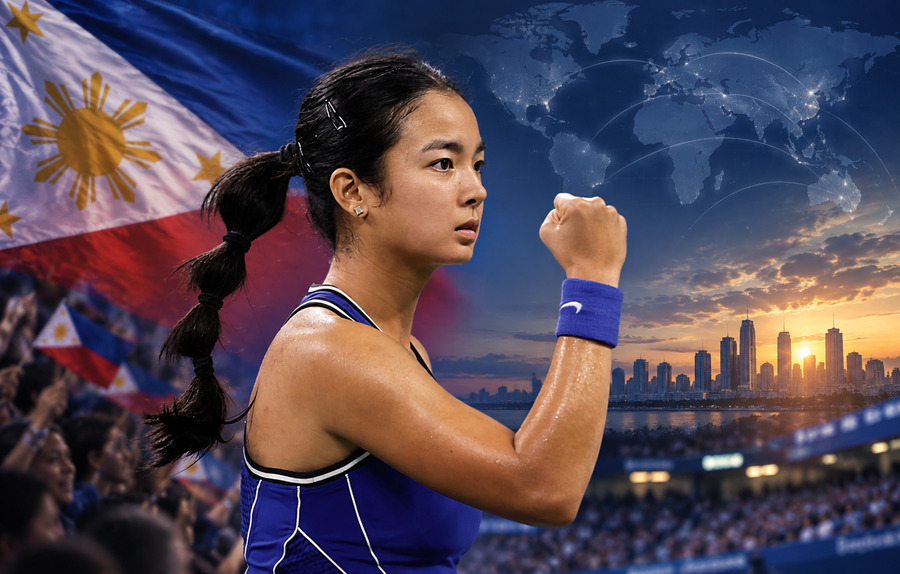
From the Philippines to the World: Why Alex Eala Means So Much to Filipinos Everywhere | There are tennis matches that are measured in sets, games, and points. Then some matches seem to carry something much bigger.
For Filipinos around the world, Alex Eala has increasingly become that kind of athlete.
At just 21, the Filipina tennis star is no longer simply a promising player representing the Philippines. She has become a symbol of possibility—a reminder that a Filipino athlete can walk onto the biggest courts in the world, compete against established champions, and belong there.
Her journey has also taken on a new dimension during the 2026 US Open, where Eala entered as the No. 17 seed, the highest-seeded Filipina in Grand Slam history. After defeating American qualifier Mary Stoiana in the opening round, she followed it with a 6-1, 6-4 victory over Ukraine’s Oleksandra Oliynykova to reach the third round for the first time at the US Open.
But the numbers only tell part of the story.
Alex Eala Is Carrying More Than a Tennis Racket
For many Filipinos, watching Eala compete is an emotional experience because her victories represent something beyond sport.
There is the young Filipino abroad who sees someone from home succeeding on an international stage. The parent is wondering whether a child should pursue an unconventional dream. There is the aspiring tennis player who suddenly has a Filipina role model competing at Wimbledon, the US Open, and other major tournaments.
And there is the overseas Filipino who sees the Philippine flag in a stadium thousands of miles from home.
That connection was unmistakable in New York.
At Louis Armstrong Stadium, Filipino fans filled sections of the venue with flags, signs and chants. The official US Open website described the atmosphere as an “Eala mania,” with supporters coming from the nearby Filipino community in Queens and beyond.
Eala understands what that means.
“I’m proud to represent Filipinos,” she told the US Open crowd after her second-round victory.
That sentence may sound simple, but its significance is enormous.
From a Filipino Dream to a Global Tennis Career
Eala’s rise has not happened overnight.
She developed her game at the Rafael Nadal Academy in Mallorca after beginning her international tennis journey at a young age. Her breakthrough moments have accumulated steadily: winning the 2022 US Open junior girls’ singles title, becoming the first Filipino player to win a Grand Slam main-draw match in the Open Era in 2025, reaching the fourth round at Wimbledon in 2026, and then winning her first WTA Tour-level singles title in Washington, D.C.
Her Wimbledon run was particularly significant.
Eala defeated defending champion Iga Swiatek and reached the last 16, another milestone for Philippine tennis. Earlier in the tournament, she became the first Filipina in the Open Era to reach the third round of a Grand Slam.
Her success in Washington followed, where she defeated Jessica Pegula in the final to become the first player from the Philippines—man or woman—to win a WTA Tour-level singles title.
Suddenly, the conversation around Philippine tennis changed.
Eala was no longer merely breaking barriers. She was establishing herself among the world’s elite.
“Anything Is Possible”
Perhaps one of the most powerful aspects of Eala’s story is that she doesn’t appear consumed by the historical significance of every achievement.
She acknowledges it, but she keeps moving.
After becoming the first Filipino player to win a Grand Slam main-draw match, Eala said, “I take so much pride in representing my country.” She also gave supporters a deceptively simple message: “Dream big.”
That message resonates deeply in a country where ambition is often balanced against practicality.
Filipino families know what it means to work abroad. They know sacrifice, long-distance relationships and starting from scratch. They know the feeling of cheering for someone from home because, somehow, that person’s success feels like a small piece of your own.
Eala’s story fits naturally into that emotional landscape.
She is showing young Filipinos that international success doesn’t have to be someone else’s story.
The Power of Seeing Filipino Identity on the Global Stage
Eala has also been intentional about bringing Filipino culture with her.
At Wimbledon, she wore a visor featuring the Tagalog phrase “Kapag lumago, hindi na hihinto”—“Once it grows, it cannot be stopped.” She explained that carrying elements of her culture onto the court is deeply sentimental because where she comes from is part of who she is.
That matters.
Globalization can sometimes make young athletes feel pressure to become universally marketable—to smooth out the cultural edges that make them distinctive.
Eala appears to be doing the opposite.
She is becoming more global without becoming less Filipino.
And Filipinos worldwide are responding to that.
At the US Open, fans have shown up wearing Filipino colors, carrying handmade signs and even bringing childhood photographs of Eala. GMA News reported that Filipino supporters in New York have packed the stadiums, while Eala has made a point of appreciating those efforts.
Her response is telling.
“I hope you guys feel the same way and [by] watching tennis, you feel love and you feel happiness as well,” she said.
More Than Winning
This may ultimately be Eala’s greatest significance.
She is teaching Filipinos to follow the process, not just the scoreboard.
After her latest US Open victory, she pointed to patience and consistency of focus as the keys to winning.
That mindset is important because professional tennis is brutally unforgiving. A player can dominate one week and lose in the first round the next. Rankings fluctuate. Injuries happen. Expectations grow.
The real challenge is learning how to keep going.
Eala seems increasingly comfortable with that reality.
“I try to live my life with happiness,” she said during the US Open.
For Filipinos watching her from Manila, Cebu, Davao, Dubai, Singapore, London, California, New York and countless other places, that attitude may be as inspiring as the victories themselves.
Because Alex Eala is not promising that every Filipino dream will come true.
She is showing what happens when someone dares to pursue one relentlessly.
A New Chapter for Philippine Tennis
The significance of Alex Eala extends beyond her current ranking, tournament results or Grand Slam record.
She is helping make tennis visible to a generation that may previously have viewed it as a niche sport. She is giving young Filipina athletes a powerful example of excellence. And she is giving overseas Filipinos another reason to gather around a screen, raise a Philippine flag and say, “Laban!”
Most importantly, Eala is still only 21.
Her story is nowhere near finished.
For now, every time she walks onto a major international court, Filipinos worldwide are watching—not simply to see whether she wins, but to witness how far a Filipino dream can travel.
And perhaps that is what Alex Eala means most of all:
She makes the world feel a little smaller—and the Filipino dream feel a little bigger.
via Bravo Filipino